Data Engineering Strategies for Next-Gen Automotive Manufacturing

Introduction
The automotive manufacturing sector is undergoing a digital revolution, driven by the integration of advanced data engineering strategies. The rise of Industry 4.0 and the Industrial Internet of Things (IIoT) has catalyzed a shift toward intelligent, interconnected production systems. In this landscape, data engineering plays a pivotal role in enabling real-time decision-making, predictive maintenance, quality assurance, and production optimization. Next-generation automotive manufacturing relies on structured and scalable data infrastructure, robust data pipelines, and intelligent analytics to meet evolving demands for speed, efficiency, customization, and sustainability.
The Role of Data Engineering in Automotive Manufacturing
Data engineering focuses on the design, construction, and maintenance of systems and architecture that enable the efficient collection, storage, processing, and analysis of massive volumes of structured and unstructured data. In the automotive industry, data engineering supports the full product lifecycle — from design and production to delivery and post-sale services.
Modern automotive plants are equipped with thousands of sensors and devices that generate terabytes of data daily. Without robust data engineering strategies, this data remains underutilized. Through data engineering, raw data can be transformed into actionable insights to improve operational efficiency, reduce costs, and enhance vehicle quality.
Core Data Engineering Strategies
1. Scalable Data Architecture
To handle the high velocity, variety, and volume of data in automotive production, manufacturers are adopting scalable, cloud-native architectures. Data lakes and warehouses such as Amazon Redshift, Google BigQuery, and Apache Hadoop provide centralized platforms for storing and querying large datasets efficiently.

Scalable architectures allow:
Real-time ingestion from IIoT devices
High-performance batch and stream processing
Integration with AI and machine learning platforms for predictive insights
2. Robust Data Pipelines
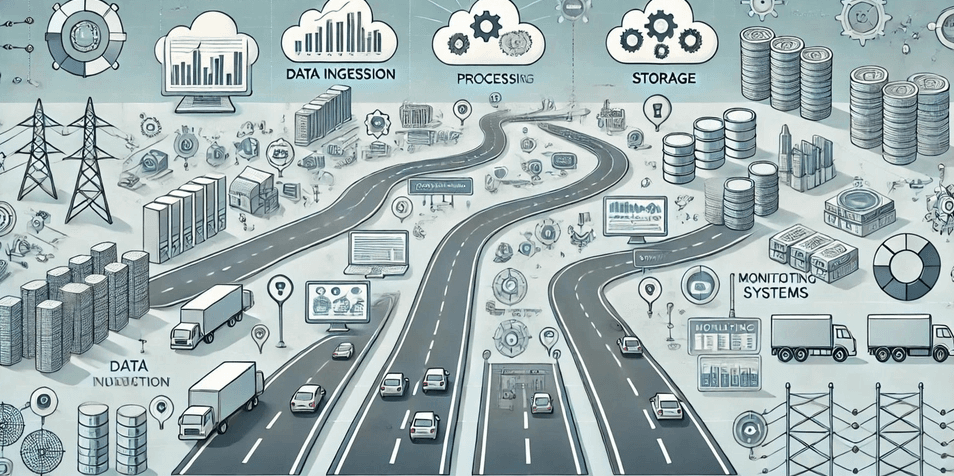
Efficient data pipelines ensure that data flows seamlessly from edge devices to analytics platforms. Modern automotive production lines require both batch and streaming data pipelines to capture diverse data formats including sensor logs, machine metrics, image data, and environmental variables.
Technologies like Apache Kafka, Apache NiFi, and Apache Spark Streaming are commonly used to build real-time pipelines that support use cases such as:
Predictive maintenance
Energy efficiency monitoring
Real-time anomaly detection
Equation (for streaming throughput):

3. Data Quality and Governance
Automotive systems demand high data fidelity for safety and compliance. Data engineering ensures data integrity through validation, deduplication, and normalization processes. Metadata management and data lineage tracking are also vital for maintaining transparency and auditability.
Key practices include:
Schema validation using Apache Avro or Protocol Buffers
Data profiling and anomaly detection
Role-based access control and encryption for security compliance (e.g., ISO 26262)

Intelligent Manufacturing Applications
1. Predictive Maintenance
Data from machine sensors (vibration, temperature, usage hours) is analyzed to predict equipment failure before it occurs. ML models built on historical maintenance data are integrated into pipelines to trigger alerts or schedule servicing.
Equation (Weibull Failure Rate Model):

2. Digital Twin and Simulation
Data engineering enables real-time synchronization between physical manufacturing systems and their digital replicas. Digital twins simulate production environments to test optimization scenarios without disrupting operations.
This strategy relies heavily on:
Sensor data integration
Edge-to-cloud synchronization
Time-series databases (e.g., InfluxDB, TimescaleDB)
3. Quality Assurance and Computer Vision
Data pipelines integrate image and video feeds with AI models for defect detection in real time. Quality analytics systems automatically flag anomalies based on pixel patterns or surface texture deviations.
Future Trends
Edge AI: On-device analytics reduce latency and bandwidth usage, critical for robotic arms and autonomous production units.
Self-healing Pipelines: Automated detection and resolution of data pipeline failures using AI-driven observability.
Sustainable Manufacturing: Integration of energy usage and emission data into decision-making for green production practices.

Conclusion
Next-generation automotive manufacturing is inherently data-driven. Effective data engineering strategies — built on scalable architectures, efficient pipelines, and intelligent analytics — form the digital backbone of this transformation. By enabling predictive, adaptive, and autonomous capabilities on the factory floor, data engineering not only increases production efficiency but also enhances product quality and sustainability. As automotive manufacturing continues to evolve, data engineering will remain a strategic pillar in shaping its future.